'Loop Engineering Is Dead' — and the Real Story Is Weirder Than the Obituary

Loops, graphs, and the six-week obituary
In June 2026, the AI world got a new buzzword: loop engineering — roughly, disciplined design of a single agent's tool-calling loop. Six weeks later it was supposedly replaced by graph engineering — wiring up several agents at once — killed by twelve words that 3.1 million people saw:
Are we still talking loops or did we shift to graphs yet?
— Peter Steinberger 🦞 (@steipete) July 18, 2026
Don't know what loop engineering is? Don't worry — neither did most of the people declaring it dead. Here are both terms, how a name became an obituary in six weeks, and the twist nobody checked before writing about it.
The split shows up best on a job with independent work that can run at once and where a wrong answer is expensive — a research briefing: "Pull together what we know about X — the open web, our own docs, and the repo — and give me a one-page brief with sources."
The OpenClaw agent you stand up in these tutorials works the loop way — one agent cycling through its tools, one turn at a time. Graph engineering wires up a team of specialists instead. Same job, two shapes:
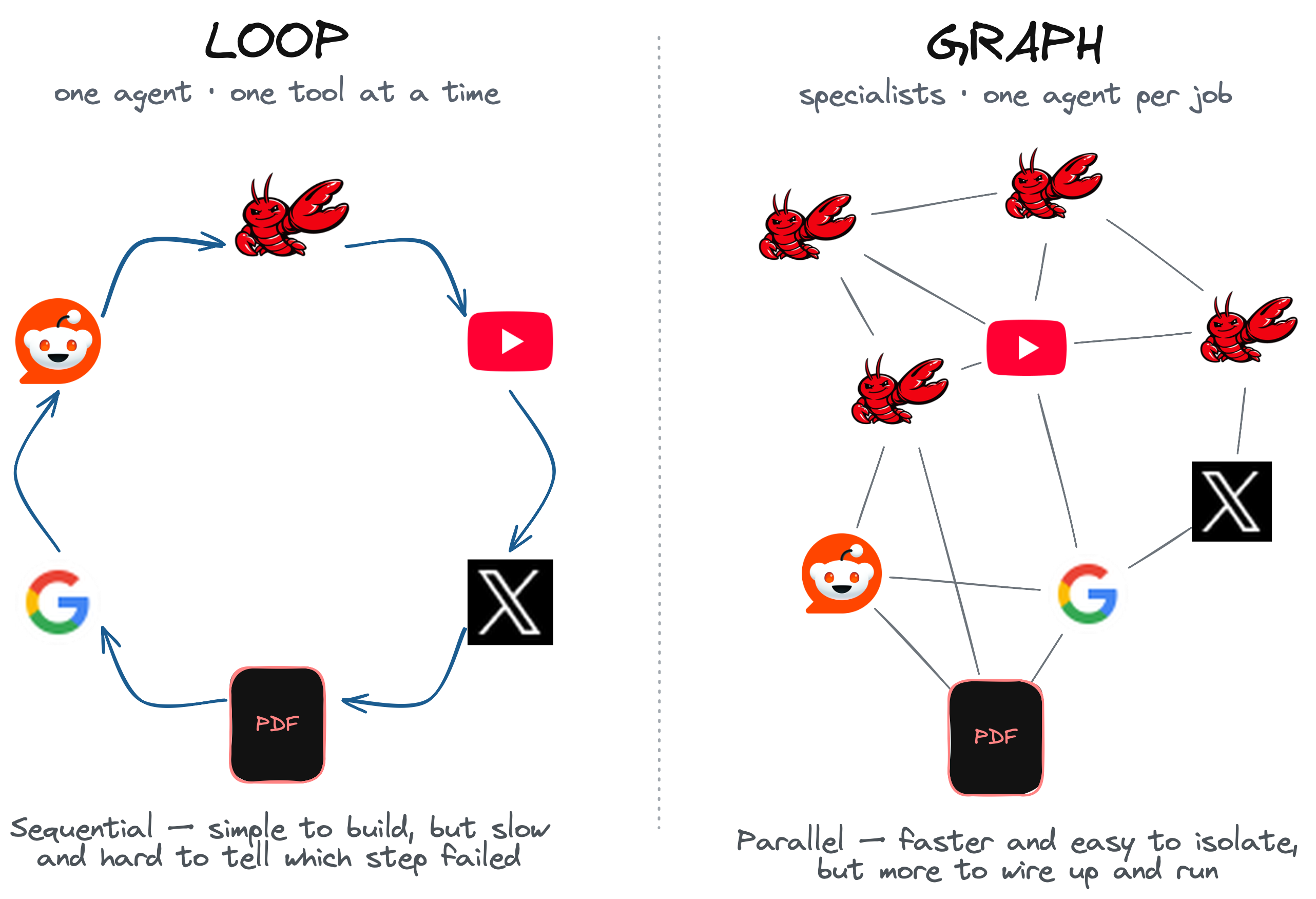
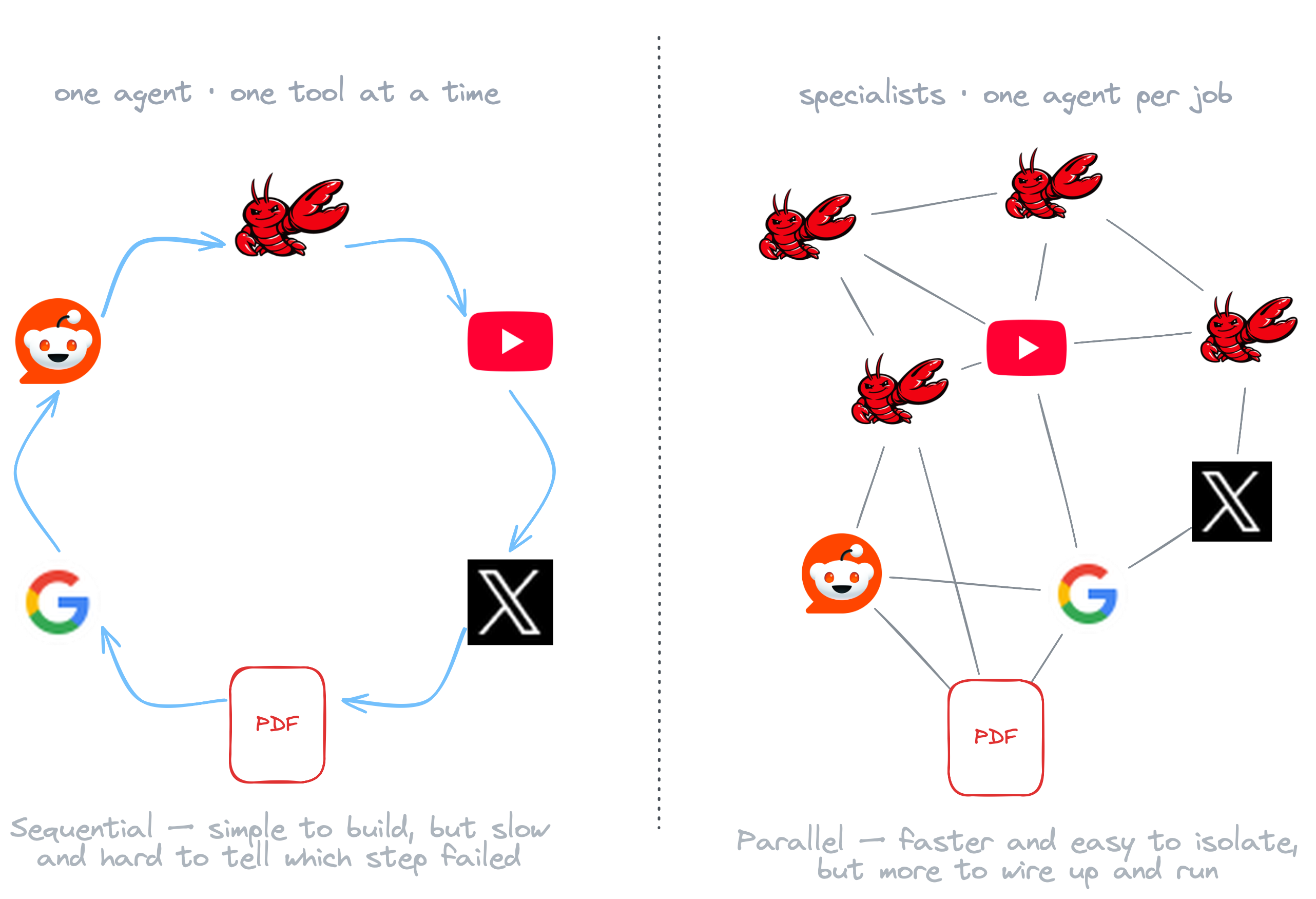
Read the loop on the left as a wheel: one agent visits each tool, then comes back around. Push it past simple tasks and two cracks appear: it's slow (three independent searches still run back-to-back, one worker at a time), and it's hard to trust (the same agent searched, read, and wrote the brief, so a wrong claim has no address — you can't tell if the search was thin or the agent invented it).
The graph on the right fixes both: specialists split the job, a planner routes it. The searches now fire at the same time — the brief lands in the time of the slowest one, not the sum — and each agent owns one source, so a bad claim has an address. A dedicated fact-check node, the step a rushed loop skips, becomes a real gate.
None of that is free: one prompt becomes a planner, four agents, and a verifier — a new failure mode where the coordination itself can break. Trust problem traded for a plumbing problem. And every box in the graph still runs its own loop inside: a graph contains loops — that's the whole point.
Both terms, in one picture
Loop engineering is about one agent. An AI agent is just a model in a while loop
with tools: give it a goal, it picks a tool, your code runs it, the result goes back in,
repeat. ChatGPT answering a question is one call. An agent that edits a file, runs the
tests, sees them fail and tries again — that's the loop, five times over. Loop engineering
is designing that cycle deliberately: what triggers it, who verifies the work, when it
stops, what happens on failure. The slogan is a good one — the intelligence lives in the
model, the reliability lives in the loop.
Graph engineering is about several agents. Nodes are agents, edges are dependencies, plus the shared state and permissions between them. If loop engineering is "make one agent reliable," graph engineering is "make ten agents not step on each other."
Different problems, different scale. So "loop engineering is dead, graph engineering replaced it" was never a sensible sentence — it's like saying wheels replaced cars.
The name for the first one arrived in June 2026, from Addy Osmani. It caught on fast because everyone was already doing it, badly, with no shared vocabulary. Remember that date.
The textbook settles it
Here's the thing nobody checked before writing a guide: "graph" isn't a 2026 coinage, and the receipts are sitting in a free MIT textbook. From Mathematics for Computer Science (6.042J), chapter 6, page 189 — Definition 6.1.1:
"A directed graph G = (V, E) consists of a nonempty set of nodes V and a set of directed edges E… A directed graph is simple if it has no loops (that is, edges of the form u→u) and no multiple edges."
The formal definition of a graph already contains the word loop, as an ordinary feature of graphs — not their opposite. Definition 6.1.2 adds that a cycle is a walk that returns to where it started, which is what a loop is.
A loop isn't the opposite of a graph. It's a graph that comes back to an earlier node. Mathematics has known this since Euler walked around Königsberg in 1736.
What actually happened in July
The fuse wasn't an engineering discovery — it was two product launches colliding. DeepLearning.AI released a course on knowledge graphs with multi-agent systems, taught by Neo4j's Andreas Kollegger. Around the same time, Linear shipped an agent feature called — of all things — Loops. Two companies, two unrelated products, two words that sounded like rival philosophies.
Then Steinberger, who built OpenClaw, posted his twelve words at 9:34 PM on July 17. Four and a half hours later Hamel Husain published an X Article titled "Loop Engineering Is Dead. Enter Graph Engineering," and Santiago Valdarrama picked it up the same day. Within 48 hours the new term had three competing definitions and a wave of copycat posts.
The part that should have ended it
Neither founding post was serious — the writers who tracked the cycle say so outright. Louis-François Bouchard put it plainly: "my whole feed decided we have a new discipline. To be honest, both tweets were jokes." Husain's own follow-up only widened the wink, promising the piece was "not what you think it is."
And almost nobody could check: the article sat behind X's Premium paywall. A paradigm's founding text was something few of the people citing it had actually read. What spread wasn't an argument — it was a shape: a punchy title, a wink right behind it, and an industry that answered a joke by writing documentation for it.
The replies were smarter than the announcements
The sharpest response came from outside the agent crowd. David Khourshid created XState — a widely-used library for modeling exactly this kind of state machine in code — and has been modelling these structures for a decade:
First it was loops. Now it's graphs. Next month it'll be something else. Here's the thing: we're constantly rediscovering decades-old software engineering patterns and repackaging them as innovations or whatever, instead of just applying what we've already known for a long time.
— David Khourshid (@DavidKPiano) July 20, 2026
His explanation takes two minutes. A state machine answers one question — given the current state, when an event occurs, what is the next state? Draw it and states become nodes, transitions become edges. Then he turns it on the July argument:
"Surprise… loops are graphs: directed, cyclic ones."
A loop, he notes, is the most basic state machine there is: two states, looping and
done. He posted a diagram of it captioned "This is the silly thing you all hyped for
weeks."
That's the object six weeks of discourse was about. And real agents — the ones that retry, backtrack, wait for a human — were never sequential and never acyclic to begin with ("sorry, DAG lovers").
The creator of LangChain got there from the opposite direction, his LangGraph being the implementation everyone kept pointing at:
So i didn't really know what graph engineering is, and i still don't really… but it's basically just langgraph?
— Harrison Chase (@hwchase17) July 20, 2026
Four days later he and Sydney Runkle published a longer answer, 3 Years of Graph Engineering with LangGraph, which is the most useful thing written during the whole episode. Their opening line is the best description of the phenomenon I've read:
"It's the latest term to come out of X's AI content factory, joining prompt engineering, context engineering, harness engineering, and loop engineering."
And then, from the people whose product is literally the graph:
"Loops are simple graphs. Loop engineering isn't an alternative to graphs, so much as a simple version of them."
They also confirm the thing most July posts got backwards: production agent graphs are usually not DAGs. Real agents retry, ask for missing information, revise after validation, pause for a human. Cycles aren't a design flaw to be engineered out — they're the job.
The clearest framing of all, though, came from a reply:
Graph engineering is deciding where the work is allowed to go. Loop engineering is making the work get better each time it runs. Graph is the rails. Loop is the motor. Rails keep you from crashing. The motor is what actually moves.
— Eric Osiu (@ericosiu) July 22, 2026
Where it stands today
It's August 5, about two and a half weeks after the obituary. Nobody won. The debate didn't resolve and it didn't die — it got absorbed by content marketing. Every agent-infrastructure vendor now has a "definitive guide to graph engineering," and behind them a long tail of SEO pages saying the same thing in the same order.
Nothing was learned in that time. No benchmark ran, no production system proved one approach beat the other. Two companies shipped unrelated products, two well-followed developers made a joke, and a lot of people agreed on a word — then agreed on a different word.
That has a real cost. If you tried to keep up by adopting each term as it trended, you rewrote your architecture twice in July for reasons that were social, not technical. Meanwhile the engineer who ignored both posts and spent that month adding stop rules and typed state came out ahead, because those mattered under any label.
The failure nobody's selling a guide for
One idea from this month deserves more attention than the naming war, and it comes from Towards AI's breakdown: more agents doesn't mean more judgement.
Twenty agents running the same model, reading the same flawed context and checking against the same broken metric will agree with each other at industrial scale. Worse is the circular version: one agent checks a report against another report, an audit agent checks both against a dashboard, and the dashboard was built from the same data. Every node agrees. Nothing touched reality. The system looks well governed, because the diagram has reviewers everywhere.
The fix is what they call reality anchors — evidence from outside the agent system. Tests that actually ran. Money that reached the bank. Customers who stayed. Rules the optimiser can't quietly rewrite. Their line is the one I'd put on the wall:
"Without anchors, a graph is a larger hallucination with better project management."
The same trap exists one level down, inside a single loop: if the agent that does the work also decides whether the work is good, you've built an expensive machine for agreeing with itself. A verifier only counts if it can actually fail you.
What to actually do
Khourshid's line is the filter, and it isn't cynicism: next month it'll be something else. When the next term lands, the question is never "is this the new paradigm?" It's "what specific failure does this name, and do I have that failure yet?"
Diagnose where your bottleneck actually is:
- One agent degrading over a long session — forgetting, repeating tool calls, burning tokens? That's a loop problem: stop rules, what tool output re-enters context, whether errors are surfaced or swallowed. No graph framework fixes any of it.
- Several agents duplicating work or deadlocking on shared state? That's a coordination problem, and it needs an explicit control plane whatever you call it.
And a case for neither: if the task is genuinely open-ended — research, exploration — forcing it into fixed paths is the wrong move. The LangChain team makes this point against their own product: they built early deep research on predefined LangGraph workflows and then moved to a looser agentic loop, and GPT Researcher did the same. Structure you haven't earned costs you.
And whichever you have, these outlive the vocabulary: every loop needs a stop rule; state needs a shape and save points; acting nodes need permission boundaries and a human gate on anything irreversible; add complexity only when a real failure asks for it.
If you want the two concepts that pay off across all of it, take Khourshid's recommendation over any of July's vocabulary: state machines and the actor model. Both predate this argument by decades and will outlive whatever replaces it — probably in about six weeks.
Sources
- Addy Osmani, naming "loop engineering" (June 2026) — X
- Peter Steinberger's post — X
- Hamel Husain, "Loop Engineering Is Dead. Enter Graph Engineering" — X Article, July 18, 2026 (behind X Premium) · his public follow-up
- Santiago Valdarrama — X
- David Khourshid (XState), "State machines in 2 minutes" — X
- Harrison Chase (LangChain) — X · Eric Osiu — X
- Louis-François Bouchard, "Graph Engineering Explained: What Actually Changed"
- "Two Engineers Made a Joke About Graph Engineering. Six Days Later It Had Courses." — AI Advances
- SmartScope, on whether the "obituary" is true
- MIT 6.042J Mathematics for Computer Science, Ch. 6 "Directed Graphs" (free PDF) — Definitions 6.1.1–6.1.2, pp. 189–191